⚠️ Educational research and a personal trading journal — not investment advice. การศึกษาเท่านั้น ไม่ใช่คำแนะนำการลงทุน. The author does not provide licensed advisory services. Investing involves risk; consult a licensed adviser before acting.
In early 2026, two Thai stocks I was watching — SCGP and STA — both formed clean breakout setups. Tight bases. Rising relative strength. Volume drying up. Then both broke out to new highs on volume.
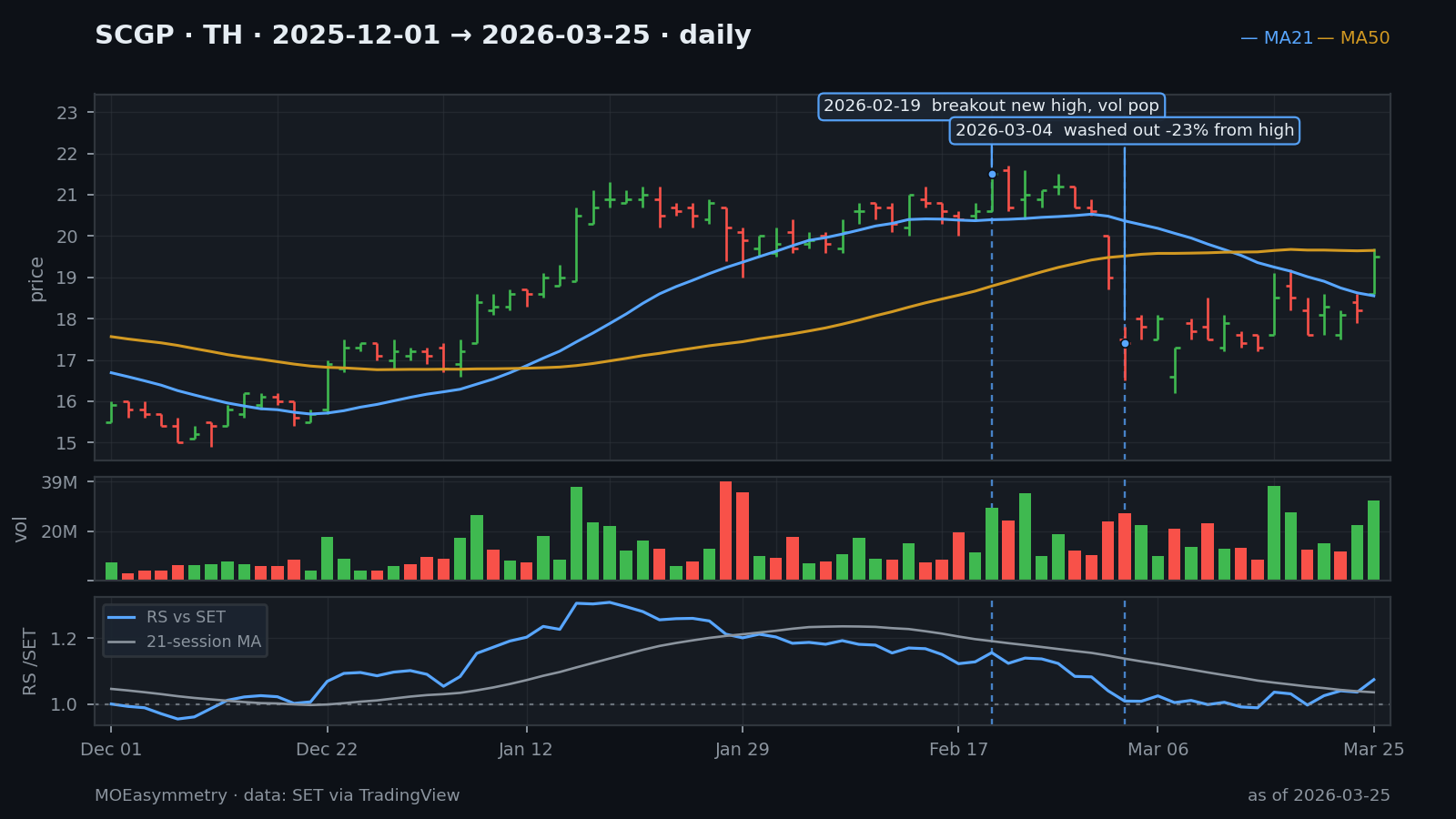
Textbook. By every rule in my playbook, valid.
Both failed within two weeks. SCGP washed out 23%. STA dropped 18%.
I spent a while looking for what I'd missed in the charts. The answer wasn't in the charts. It was in the calendar: in those exact two weeks, the SET index fell 7.4%. The whole market rolled over. Two unrelated stocks, identical setups, identical fate — because the tide went out underneath both of them.
This is the lesson that took me longest to accept, and it's the one almost no trading content will tell you:
Your setup is maybe 30% of the outcome. The market regime is most of the rest.
The data is brutally clear
I tested my breakout method across every Thai stock back to 1990, and every US stock too — point-in-time, after costs, no cherry-picking. Then I split the results by the market's condition at the moment of entry.
In Thailand, breakouts in a confirmed uptrend returned about +0.35R per trade. The same setups during a market correction? Negative.
In the US, it was even starker. I bootstrapped the results — re-sampled the trades 1,500 times to build a confidence interval, the statistical test for "is this real or luck?" The verdict:
- US breakouts in a confirmed uptrend: a real, positive edge (the confidence interval cleared zero).
- US breakouts without the uptrend filter: indistinguishable from noise. Zero. Nothing.
Read that again. In the US, the entire edge of my method — every bit of it — came from only taking trades when the market itself was healthy. Strip out the regime filter and a 36-year, decades-tested setup becomes a coin flip.
Why this is so hard to internalize
Because it feels like skill is in the stock picking. You found the tight base. You spotted the volume dry-up. You timed the pivot. It feels like that's the edge.
It isn't. The edge is only showing up when the casino is paying out. A great hand of cards is worth nothing at a table that's rigged against you that day. The market is the table.
This is why my method has a non-negotiable gate before any of the chart rules even apply: is the market in a confirmed uptrend? If the answer is no, the cleanest setup in the world doesn't get traded. Not "trade it smaller." Not traded.
How to actually use this
You don't need a fancy model. A simple, honest read of market health works:
1. Is the index above a rising long-term average (e.g., 200-day)? Trend intact. 2. Are down days coming on higher volume than up days, repeatedly? That's institutions selling — distribution stacking. When that count climbs, the table is turning. 3. Has there been a recent follow-through day — a strong up day on rising volume that confirms a new rally? That's the "all clear."
When the market is healthy, take your setups at full size. When it's under pressure or correcting, wait. Your best ideas will still be there — and they'll work — when the tide comes back in.
The uncomfortable freedom in this
It means a lot of your losses were never your fault. You didn't misread the chart. You read it perfectly — and traded it into a falling market. That's not a skill problem; it's a timing problem, and timing the market's regime is something you can control, simply by sitting out.
It also means the most powerful thing you can do as a breakout trader isn't finding a better setup. It's developing the patience to not trade when the market says no — and the discipline to strike hard when it says yes.
Track the patterns. Study what works. Wait for the market. Strike.
That third word is the one that costs people the most.
Personal research and trading journal, not investment advice. The author does not provide licensed advisory services. Markets carry risk; your decisions are your own. — MOEasymmetry