⚠️ Personal research and trading journal — not investment advice. The author does not provide licensed advisory services.
Volume is the second thing I look at on a breakout day. The first is price — did it clear the pivot? But volume is what tells me whether to believe it.
Getting this read wrong is easy. Most traders compare breakout volume to a 50-day average and call it confirmed. That comparison is usually fine, but it can fail you in the exact situations where you need confidence most: stocks that have been genuinely quiet, building real structure, with institutions gradually stepping away from their distribution. By the time that stock breaks out, its volume baseline may be low enough that a moderate pop reads as "average." The better comparison is right next to you on the chart.
Volume is a two-act story
The way to read breakout volume is not as a single number on a single day. It's a story with two acts that belong together.
Act 1: The dry-up. In the days before the breakout, volume should shrink. Not a little — noticeably. Sellers are gone. Shares aren't changing hands because there's no urgency to sell. The stock is quiet. This quiet is not boredom; it's equilibrium under compression. If you see big volume continuing through the base, be careful: that's distribution in progress, not coiling.
Act 2: The pop. On the breakout day, volume surges versus those quiet days. The contrast is the signal — not just the absolute level. Price cleared the pivot and buying volume showed up at the moment it mattered.
Without Act 1, Act 2 means less. A large-volume day after a large-volume base is just noise with a price move.
The reference point that matters
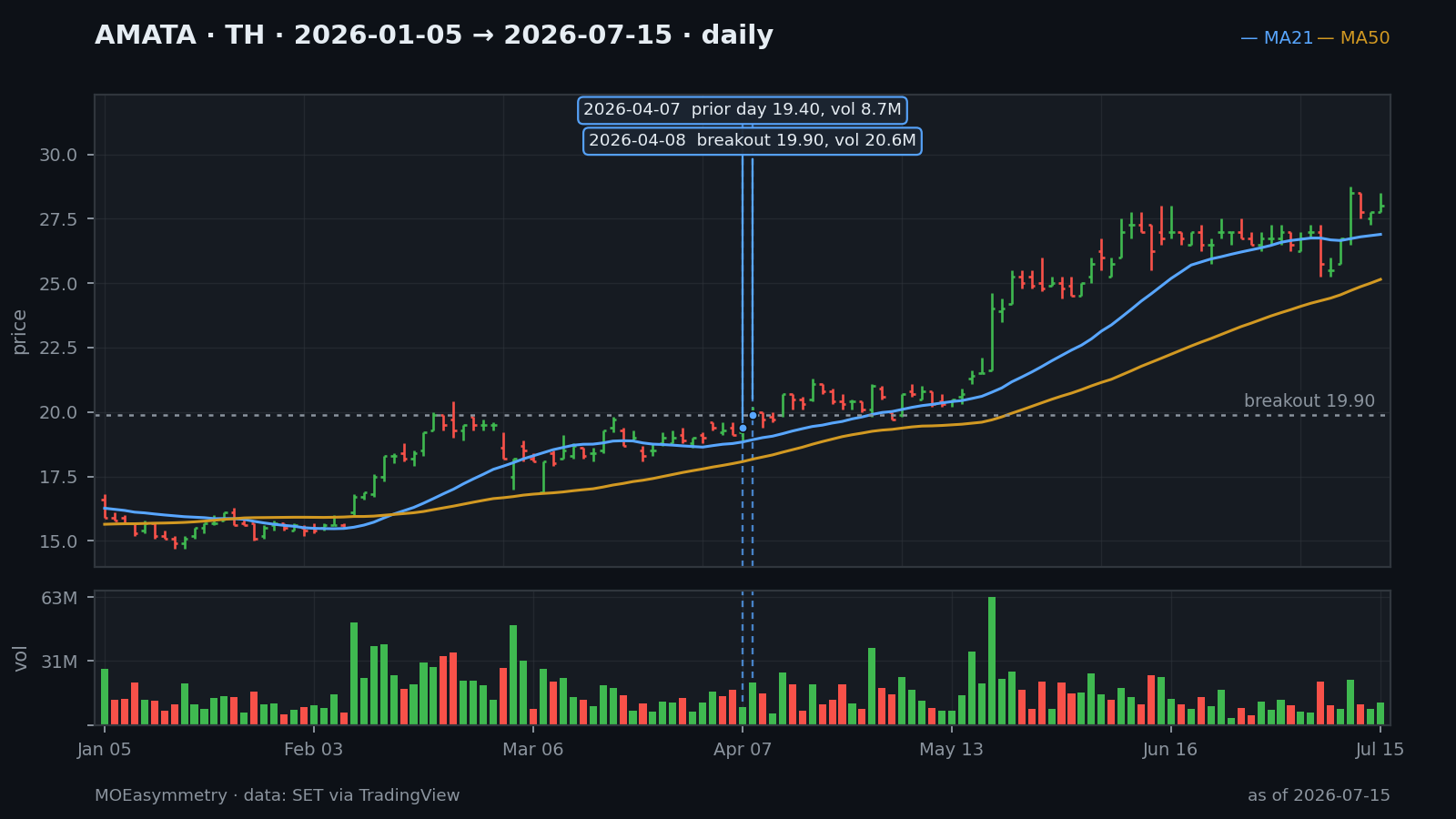
The comparison that reveals the pop is the days immediately before the breakout — the dried-up days at the end of the base — not a 50-day moving average of volume.
Here's why the distinction matters: a stock that has been genuinely quiet for two to three weeks will have recent days with very low volume. A single pop of 2× versus those quiet days is a real signal. But if you compare that same breakout day to the 50-day average (which includes noisier days from earlier in the base), the ratio might only be 1.1× — which looks like nothing.
AMATA on the Thai exchange is the clearest example I have. On its breakout day, volume came in at 20.6 million shares against 8.7 million the day before: 2.4× the prior day. By the 50-day average comparison, it was only 1.1× — barely above average. A mechanical 50d-avg filter would have flagged it as a weak breakout. It was the opposite.
The prior-day comparison is honest. It measures the actual contrast between the quiet and the shout.
What good breakout volume looks like
You are looking for three things together:
1. Dry-up confirmed. The last 3–7 days before the breakout have volume noticeably below recent weeks. The bars are short. The stock is resting.
2. A visible surge. The breakout day bar is conspicuously taller than the days before it. You should be able to see it without doing math. If you have to squint, it isn't there.
3. The timing is right. The surge happens on the day price clears the pivot — not a day before, not three days after. Late-arriving volume is accumulation, not a breakout signal.
When all three align, you have confirmation. Any two is worth attention. One alone is not enough.
What to do with a quiet breakout
Sometimes price clears a pivot on lower volume. This can mean different things:
- Potentially valid. Tight, extended consolidations — especially flat-base-style bases where the stock has been dormant for months — sometimes break quietly and then confirm with volume the next day or two. Watch it for 2–3 sessions before giving up.
- Suspicious. If price breaks on low volume and then immediately retreats back into the base, that's a failed breakout. The move had no conviction behind it. Cut it quickly; these tend to keep falling.
- Market context matters. A quiet breakout in a confirmed uptrend is different from a quiet breakout during a market correction. In an uptrend, quiet breakouts get some benefit of the doubt. In a correction, they usually fail.
The rule I apply: if price cleared the pivot convincingly but volume was thin, I'll watch for one to two days for volume to follow. If it doesn't appear within two sessions, I either reduce or pass. I don't hold a weak-volume breakout waiting for it to become a strong one.
Why this matters more in Thailand than the US
I've tested this quantitatively. In Thai stocks, requiring a prior-day volume pop to confirm a breakout improves walk-forward performance: the confidence interval is fully above zero, meaning the improvement is real, not noise. In US stocks, the same rule degrades performance slightly — the signal disappears.
The likely reason: Thai institutions move price when they buy. A volume spike in a Thai stock is visible, confirmable evidence of real demand arriving. US institutions move differently — they accumulate over weeks, split orders, minimize footprint. By the time a US stock breaks its pivot, the institutional buying may be partly done. Quiet breakouts in US leaders are often the best ones.
The practical implication: in Thai stocks, treat the volume pop as a required element. In US stocks, treat it as supportive evidence — useful if present, not fatal if absent.
This is also why you can't copy a rule from one market directly to another without testing it. The same signal can have opposite effects depending on market structure.
The read in one sentence
Silence building, then a shout on the day price breaks out — that's what you're looking for. If you see both, you have a real move. If you see only the price move, wait and see.
Track. Study. Wait. Strike.
Personal research and trading journal — not investment advice. The author does not provide licensed advisory services. — MOEasymmetry
Draft 2026-06-11. AMATA case: 20.6M vs 8.7M prior-day = 2.4×, only 1.1× 50d-avg. Thai volume-pop validated (CI excl. 0, +0.17R lift). US: neutral/slightly negative. Source: volume_pop_rigor_retest_2026-06-10 + anatomy AMATA case study.