⚠️ Personal research and trading journal — not investment advice. The author does not provide licensed advisory services.
One of the more surprising findings from backtesting the contracting-base method across both Thai and US markets is that the optimal base length is not just different — it's inverted.
In Thailand, medium-length bases outperform. Very short bases are too noisy; very long bases underperform the medium ones. The relationship forms an inverted-U.
In the US, longer bases are better. A stock that consolidated for 13 or more weeks before breaking out outperforms one that formed a 4–6 week base. The relationship is roughly monotonic: more time in the base, better performance.
Same method. Same logic. Opposite empirical findings.
What the Thai data shows
Across the 36-year Thai backtest, I split trade outcomes by how long the base took to form (measured in weeks from the first lower-high to the breakout):
| Base length | Relative performance |
|---|---|
| Very short (1–3 weeks) | Below average — too noisy, often not a real base |
| Medium (4–10 weeks) | Best — the sweet spot |
| Long (10–18 weeks) | Slightly below medium |
| Very long (18+ weeks) | Underperforms — weakest category |
The very-long base underperformance makes intuitive sense in the Thai market context. A stock that has consolidated for 18+ weeks in Thailand has often done so because institutional interest is limited. The leadership pool is smaller; a genuine leader typically breaks out within a few months of building a proper structure. When a Thai stock drifts sideways for 4–5 months, it often signals that the move isn't coming — the stock is stuck, not coiling.
There's also a practical consideration: very long bases in Thai stocks often have data-quality or corporate-action events (rights issues, dividends, trading halts) that can distort the base structure.
What the US data shows
The US result is the mirror image:
| Base length | Relative performance |
|---|---|
| Short (1–4 weeks) | Weakest |
| Medium (5–8 weeks) | Average |
| Long (8–13 weeks) | Above average |
| Very long (13+ weeks) | Best |
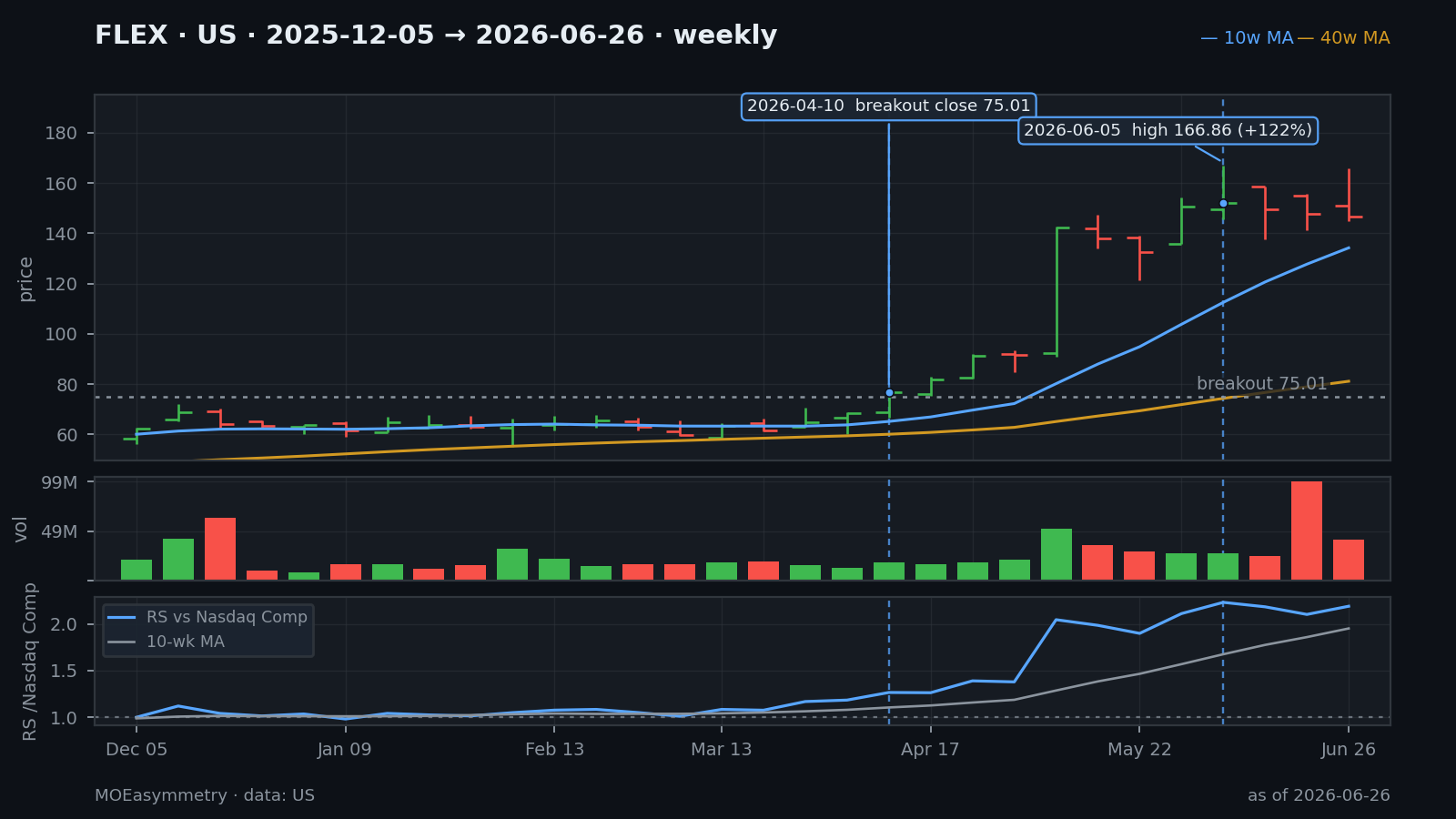
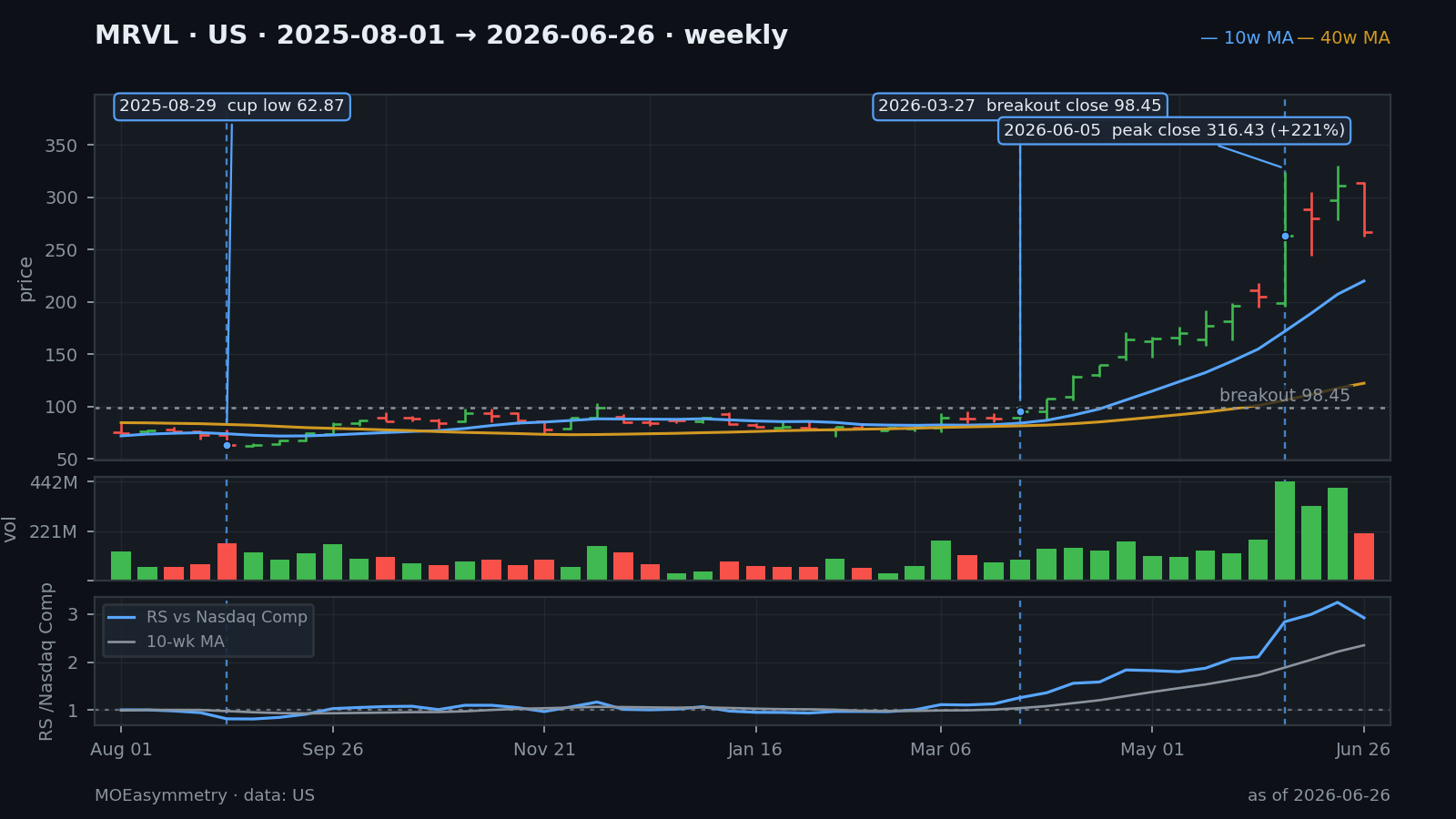
The cases that validated this most clearly in my study were MRVL (a long cup base over roughly 30 weeks) and FLEX (a similar extended consolidation). Both produced multi-hundred-percent moves from the breakout. The long base filtered out weak hands completely and produced a tightly wound, high-conviction launch point.
Why do longer US bases work better? A few mechanisms:
1. Institutional accumulation takes time at scale. A fund building a large position in a $50B market-cap company can't do it in two weeks without moving the price. Extended consolidations in US large-caps often reflect patient accumulation, not lack of interest.
2. Longer bases mean more compression. The longer a stock holds a tight range, the more supply is absorbed. When the break finally comes, there's very little overhead.
3. US market efficiency. The US market is more efficient — short-term setups get arbitraged faster. The edge in US breakouts tends to sit in the longer, more "boring" setups that don't attract fast-money attention.
The practical implication
If you're scanning both markets, don't apply the same base-length criteria to both.
For Thai stocks: favor medium-length bases (4–10 weeks). Treat very-long Thai bases with skepticism — the longer the base, the more worth asking why the stock hasn't moved yet.
For US stocks: longer bases are not a concern. A 20-week flat base in a US market leader is often a better setup than a 5-week one. The US MRVL and FLEX examples both had extended consolidations before multi-hundred-percent moves.
For both: the shape matters more than the length. Contracting pullbacks — higher lows, tightening volatility — are the invariant. Length is a secondary read that tilts probability; shape is the primary read.
Why opposite findings are worth trusting more
It might be tempting to dismiss a finding that contradicts conventional wisdom. Most trading education says "look for the tight, compressed base" without specifying a maximum length. The finding that very-long Thai bases underperform is unusual.
But the fact that the same backtest produces different results for different markets is actually evidence that the test is working correctly. If both markets had shown identical relationships, that might suggest the result was an artifact of the method rather than a real market characteristic. Markets have different structures, different participant compositions, different liquidity regimes. They should respond differently — and they do.
Different markets, different optimal settings. Test in the market you actually trade.
Track. Study. Wait. Strike.
Personal research and trading journal — not investment advice. The author does not provide licensed advisory services. — MOEasymmetry